Customer story · BITS Pilani
How BITS Pilani researchers image ultrafast electron dynamics on Jarvislabs
A GPU-enabled VM for ab-initio TDSE simulations of photoelectron momentum distributions, running Julia and CUDA.jl workloads without changing an established workflow.
3D
ab-initio TDSE simulations on GPUs
Julia
TDSE code accelerated with CUDA.jl
0
changes needed to deploy on Jarvislabs
The workload
Imaging electron dynamics in momentum space.
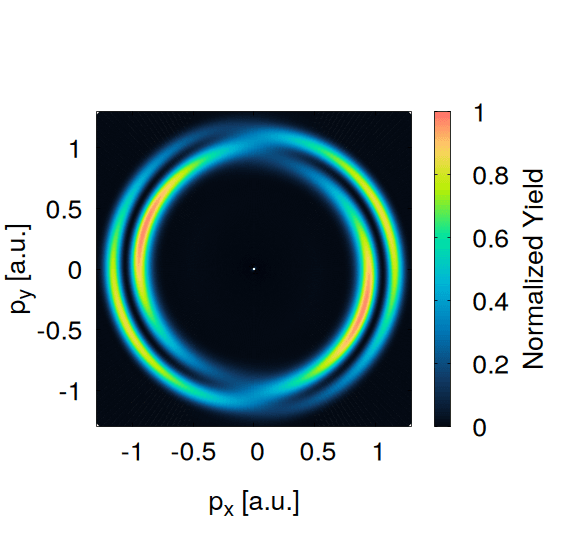
The research group in the Department of Physics at BITS Pilani studies ultrafast light-matter interactions, with a particular focus on extreme-ultraviolet (XUV) ionization and photoelectron momentum distributions (PMDs). PMDs are a cornerstone of modern applied atomic, molecular, and optical (AMO) physics, providing a direct momentum-space image of the electron following photoionization. Unlike an angle-integrated ionization yield, a PMD retains both the energy and angular information of the emitted electron, making it a highly sensitive observable of the underlying quantum dynamics.
- 01
Ab-initio TDSE simulations
In-house Julia code with CUDA.jl running on a GPU-enabled VM.
The group solves the three-dimensional time-dependent Schrödinger equation to model extreme-ultraviolet ionization, implemented in Julia with CUDA.jl for GPU acceleration. The framework deploys on the Jarvislabs VM without any code changes.
Explore GPU VM - 02
Large parameter scans
Sweeps across XUV wavelengths, delays, intensities, and polarizations.
Investigating photoelectron momentum distributions over different XUV wavelengths, pulse delays, intensities, polarizations, and phases requires a substantial number of computationally intensive simulations, run as large parameter scans on additional GPU capacity.
Explore pricing - 03
Elastic capacity alongside institute compute
Additional GPU resources when dedicated institute capacity is unavailable.
Institute GPU infrastructure is shared across multiple research activities, so dedicated availability varies with demand. Jarvislabs complements it by providing additional computing capacity when required, giving the group greater flexibility for computationally demanding studies of ultrafast electron dynamics.
Explore GPU VM
Why Jarvislabs
More compute without changing the workflow.
PMDs connect measurable electron emission patterns with atomic structure, laser polarization, interference between ionization pathways, electron-field interactions, and the phase and coherence of photoelectron wave packets, providing a powerful route to understanding and controlling electron dynamics on ultrafast and attosecond time scales. Institute GPU infrastructure is shared across research activities, so the availability of dedicated GPU resources can vary with demand. Jarvislabs provided additional computing capacity when required. The group's existing framework deployed on Jarvislabs without modification, letting them continue large parameter scans and computationally demanding simulations within their established workflow.
“We have recently started testing our three-dimensional TDSE solver on the JarvisLabs platform, and we have been able to achieve smooth and stable runs on your GPUs with very little effort from our end. The ease with which we could set up the computational environment, deploy our existing research code, and start meaningful calculations was particularly impressive to us.”
Prof. Amol R Holkundkar · Department of Physics, BITS Pilani · Compute provider for ultrafast light-matter interaction research
Results and observations are reported by the BITS Pilani research group and reflect their workloads and testing environments.
Build on Jarvislabs
One cloud from first experiment to final run.
Bring your existing computational frameworks and access additional compute when shared infrastructure is in use, without changing your established workflow.